A Practical Guide to Certifications for Wooden Cutlery Buyers
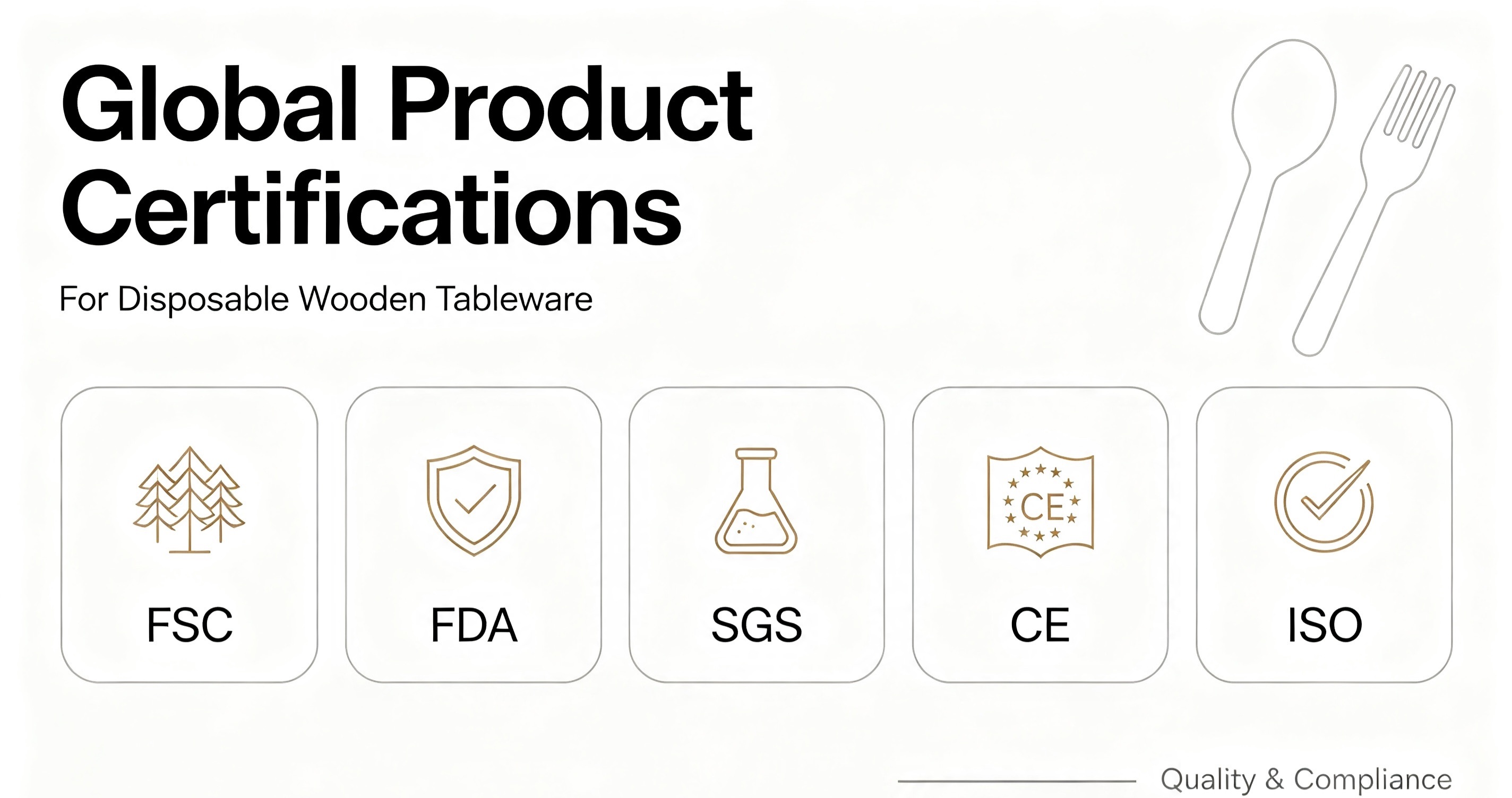
A Practical Guide to Certifications for Wooden Cutlery Buyers
Certifications come up in almost every sourcing conversation, but they are often treated as a checklist rather than something buyers actually understand. A supplier sends over a folder of logos, and the buyer files it away without knowing which certificates matter and which are just decoration.
This article explains the seven certifications most commonly referenced in the wooden cutlery industry. For each one, we cover what it actually certifies, who issues it, and why a buyer should care.
Which ones matter depends on your market, your customers, and your compliance requirements. The goal here is simply to help you read the paperwork with more confidence.
FSC – Forest Stewardship Council
What it covers: The origin of the wood.
Who issues it: Independent certification bodies accredited by the Forest Stewardship Council.
Validity: Typically 5 years, subject to annual audits.
FSC certification confirms that the wood used in a product comes from forests managed according to specific environmental and social standards. It covers the entire chain, from forest to finished product, which is why it is often referred to as a chain-of-custody certification.
For wooden cutlery, FSC matters most in the European market. European buyers, particularly in Germany, the UK, and Scandinavia, increasingly require FSC documentation as part of their sustainability commitments. Without it, a supplier may be excluded from tenders before price is even discussed.
One limitation: FSC certifies where the wood comes from, not the quality of the finished product. A factory can hold FSC certification and still produce cutlery with rough edges.
FDA – U.S. Food and Drug Administration
What it covers: Food contact safety for the U.S. market.
Who issues it: The FDA does not issue certificates. Compliance is verified through third-party laboratory testing against FDA standards.
Validity: Test reports are usually valid for the specific product and production batch tested.
FDA compliance means the product has been tested and confirmed safe for food contact under U.S. regulations. For wooden cutlery, this typically involves testing for substances that could migrate into food, such as heavy metals or residual chemicals.
An important distinction: there is no such thing as an "FDA certificate." Any supplier claiming to hold one should be asked for the actual test report. What matters is whether the specific product being purchased has been tested.
LFGB – German Food and Feed Code
What it covers: Food contact safety for the German and broader European market.
Who issues it: Testing is carried out by accredited laboratories, often following the LFGB framework alongside EU regulations.
Validity: Test reports apply to the specific product and materials tested.
LFGB is often described as stricter than FDA in certain areas. It includes sensory testing, which means the product is assessed for odor and taste transfer to food, not just chemical safety.
For buyers selling into Germany, Austria, or Switzerland, LFGB testing is frequently requested. It is also increasingly accepted as a quality signal in other European markets.
SGS – Société Générale de Surveillance
What it covers: Third-party testing and inspection.
Who issues it: SGS is an independent testing, inspection, and certification company.
Validity: Depends on the report type, typically per shipment or per product batch.
SGS is not a standard in itself. It is a testing company that issues reports against various standards, including FDA, LFGB, and others.
When a supplier says they have "SGS testing," the useful follow-up question is: tested against what standard, and for which specific product? An SGS report is only meaningful when you know what it was testing for. A report for one product does not automatically apply to another.
BSCI – Business Social Compliance Initiative
What it covers: Working conditions and social compliance.
Who issues it: Audited by independent firms under the amfori BSCI framework.
Validity: Audit results typically valid for one year, with follow-up audits.
BSCI assesses factory working conditions, including working hours, wages, safety, and employee treatment. It is not a product certification and does not relate to food safety.
For European buyers, particularly retailers and larger brands, BSCI or an equivalent social audit is often a prerequisite. It reflects whether the factory meets basic labor and ethical standards, which matters for brand reputation and regulatory compliance.
ISO 9001 – Quality Management System
What it covers: Internal quality management processes.
Who issues it: Certification bodies accredited under ISO.
Validity: Typically 3 years, with annual surveillance audits.
ISO 9001 certifies that a factory has a documented quality management system in place. It does not certify that any specific product meets a specific quality standard.
What it tells a buyer: the factory has defined procedures for production, inspection, and corrective action. What it does not tell a buyer: whether the product itself is good. That still depends on the factory actually following its own system.
ISO 14001 – Environmental Management System
What it covers: Internal environmental management processes.
Who issues it: Certification bodies accredited under ISO.
Validity: Typically 3 years, with annual surveillance audits.
ISO 14001 certifies that a factory has a system for managing its environmental impact, including waste, energy use, and emissions.
For wooden cutlery manufacturers, this is relevant because production involves wood waste, dust, and water use. A factory with ISO 14001 has documented procedures for handling these. It does not certify that the product is environmentally friendly, but it does indicate the factory manages its operations with environmental factors in mind.
Quick Reference Table
| Certification | Covers | Market Relevance | Key Point for Buyers |
|---|---|---|---|
| FSC | Wood origin and chain of custody | Essential for EU | Confirms sustainable sourcing, not product quality |
| FDA | U.S. food contact safety | Essential for US | No certificate exists, only test reports |
| LFGB | German/EU food contact safety | Essential for DE, AT, CH | Stricter than FDA in sensory testing |
| SGS | Third-party testing | Global | Ask what standard and which product |
| BSCI | Social compliance | Important for EU retailers | Not product-related, audits working conditions |
| ISO 9001 | Quality management system | Global | System certification, not product certification |
| ISO 14001 | Environmental management system | Global | System certification, not product certification |
How to Read a Supplier's Certificate Folder
When a supplier sends a set of certificates, three questions help sort through them:
1. What does this certificate actually cover?
2. Is it a product certification, a system certification, or a test report?
3. Does it apply to the specific product being ordered?
A certificate that covers the factory does not automatically cover the product. A test report for one item does not automatically apply to another. Confirming these details early prevents problems at customs and with your own customers.
Final Note
Certifications are useful, but they are not a substitute for understanding what you are buying. A supplier with seven certificates can still ship a product with rough edges if the production process is not properly controlled. A supplier with fewer certificates may produce excellent products.
The right approach is to use certifications as one input among several, alongside samples, factory audits, and references.
If you have questions about specific certifications for wooden cutlery, feel free to contact us.